Level 3, Gallery 3, SAM at Tanjong Pagar Distripark
General Admission (Free for Singaporeans and PRs)
Elia Nurvista and Bagus Pandega: Nafasan Bumi ~ An Endless Harvest
Artists Elia Nurvista and Bagus Pandega explore how the demands of a relentless extraction, from plantations to electric futures, cast a shadow on the very "breath of the Earth."
Elia Nurvista and Bagus Pandega: Nafasan Bumi ~ An Endless Harvest imagines the afterlives of materials that persist long after their use, outlasting our time in this age of excess. Plantations, mining sites, and the promise of electric vehicle technologies become places where the stories of tomorrow are formed, bound by Indonesia’s extractive economies whose resources sustain the pulse of today’s global demand.
From the need for oxygen to nickel’s role in lithium-ion technologies, from the cutting down of forests to palm oil’s many applications, these materials represent the state of the Earth’s breath (Nafasan Bumi) today, strained by extraction. The planet’s natural rhythms no longer move freely but are drawn into the labour of industry, breathing through the exhaustion of a harvest that never ends.
Across the exhibition, labour appears as both memory and speculation, a rhythm shared by humans, machines, and the living world. Conveyor belts, once emblems of the industrial revolution and the mechanisation of labour, now hum to the pulse of tropical plants, creating a continuous cycle of productivity. Nearby, sculptures cast in palm oil wax evoke the stillness of carved stone yet resist ideals of perfection, creating a dreamscape haunted by plantation residues. Others, made from discarded palm waste, hold the tension between fragility and endurance.
Together, these artworks trace how human and non-human life have been enmeshed in cycles of ceaseless pursuit of productivity, asking: What will the future shaped by these material conditions? Like the recurring haze that engulfs Indonesia, Singapore, and Malaysia during the southwest monsoon, the Earth’s breath, shadowed by an endless harvest, lingers as a reminder of what extraction conceals and refuses to let us forget. ~
about the artists
Bagus Pandega Bagus Pandega (b. 1985, Jakarta) is an artist based in Bandung, whose practice interrogates Indonesia’s ecological and socio-political conditions. He incorporates elements such as programming, industrial machines, sound systems, and plant biofeedback into immersive kinetic systems. Through this dynamic interplay, Bagus reveals the entangled legacy of Indonesia’s colonial history and its abundant natural resources, highlighting how extractive economies have shaped both landscapes and lives. His installations not only trace the scars of environmental degradation but also give voice to the lived realities of communities across Indonesia, surfacing the tensions between technological progress, capitalism, industrialisation, and human existence.
Bagus received his Bachelor of Arts in Sculpture in 2008 and his Master of Fine Arts in 2015 from the Faculty of Art and Design at Institut Teknologi Bandung. Recent notable exhibitions include solo presentations, Daya Benda (2025) at Swiss Institute, New York and Sumber Alam (2025) at Kunsthalle Basel, Switzerland, WAGIWAGI (2022) at Documenta 15 in Kassel, Germany, and the 10th Asia Pacific Triennial (2021–22) at QAGOMA, Australia.
Elia Nurvista Elia Nurvista (b. 1983, Yogyakarta)is an interdisciplinary artist whose practice scrutinises the politics of food, exploring its relationship with the power dynamics and socio-economic inequalities in this world. Utilising a wide range of media, including sculpture, batik, performance art and video installations, she engages with the social implications of the food system to critically address wider issues such as ecology, gender, class and geopolitics. In 2015, Nurvista initiated Bakudapan, a study group collective that undertakes community and research projects on food’s broader role within culture. She is also part of Struggles for Sovereignty: Land, Water, Farming, Food, a collective platform that aims to build lasting solidarity between Indonesian and international groups who are engaged in struggles for the right to self-determination over basic resources.
Elia was awarded the 2025 Villa Roman Prize. Recent exhibitions include Diriyah Biennale, Saudi Arabia (2024); Sharjah Biennial (2023), UAE; Karachi Biennale, Pakistan (2019); and the 9th Asia Pacific Triennial of Contemporary Art at QAGOMA, Australia (2018), amongst many others. She has exhibited widely in group and solo exhibitions around the world.
artwork highlights
related programmes
DROP-IN ACTIVITIES
Stamping Station
Create your own special exhibition postcard and bring home a little piece of Nafasan Bumi ~ An Endless Harvest!
Single-channel video on loop, programmed motorised conveyor machine, DIY-modified Tripteron 3D printer, Sidoarjo mud filament and customised pegboard. ; Dimensions variable; Conveyor system engineering: Ario Wibhisono; Filament collaboration with Indofilam; Collection of the artist ;
Three-channel video on live feed, nickel-plated copper-coated sculpture, DIY nickel-plating solution, aquarium; Dimension variable; Collection of the artist;
Elia Nurvista Bodies in Penumbra: The Soft Machinery of Light
2026
Resin, wax, processed oil palm fronds and palm trunk; Dimensions variable; Collection of the artist
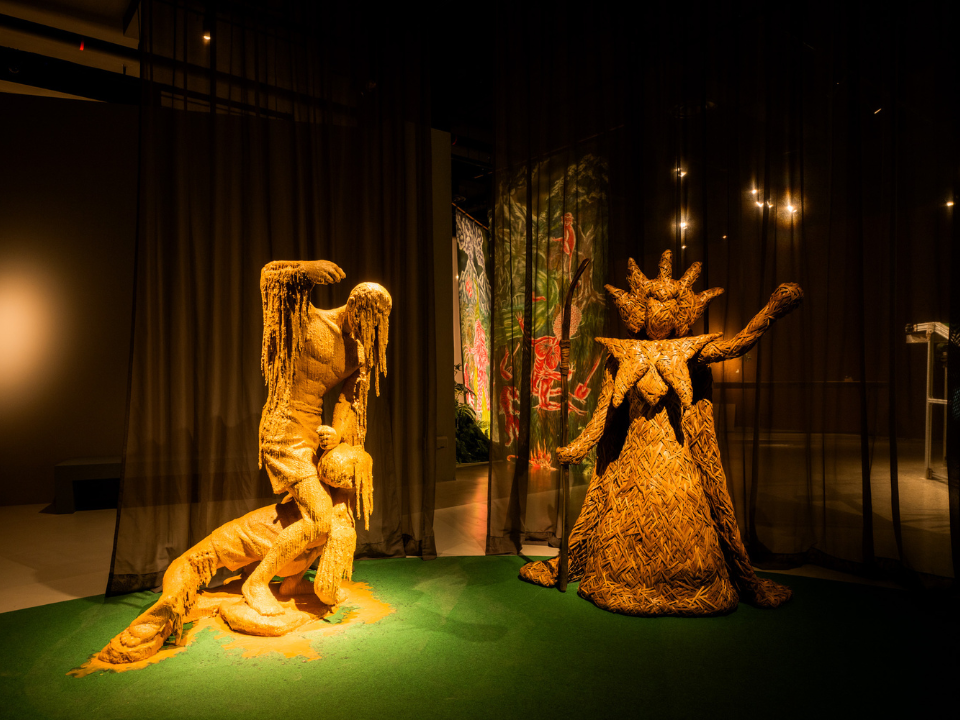
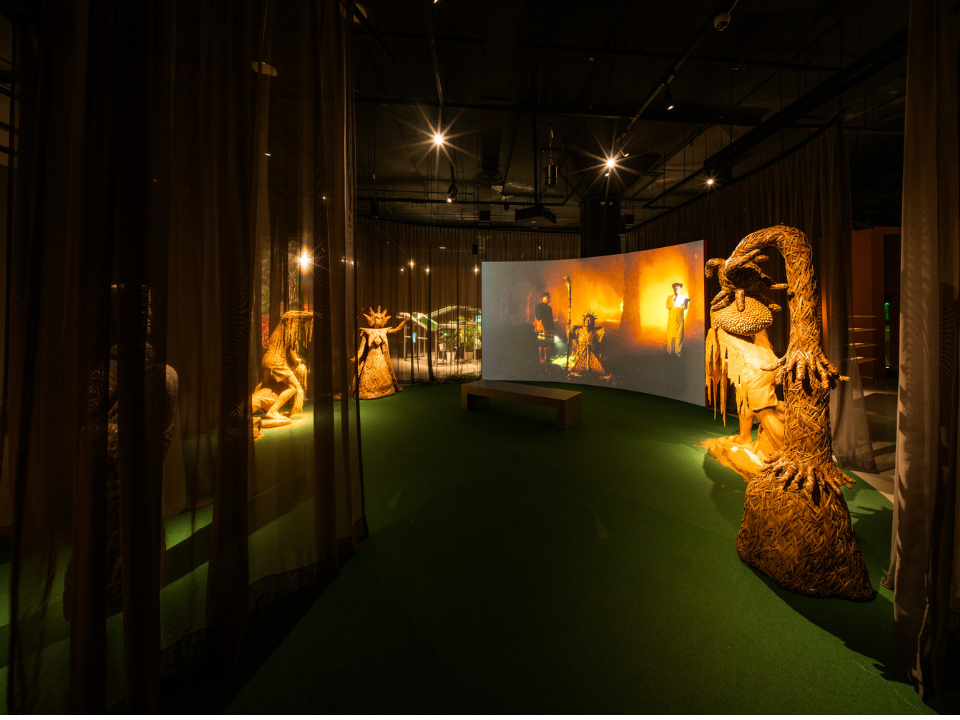
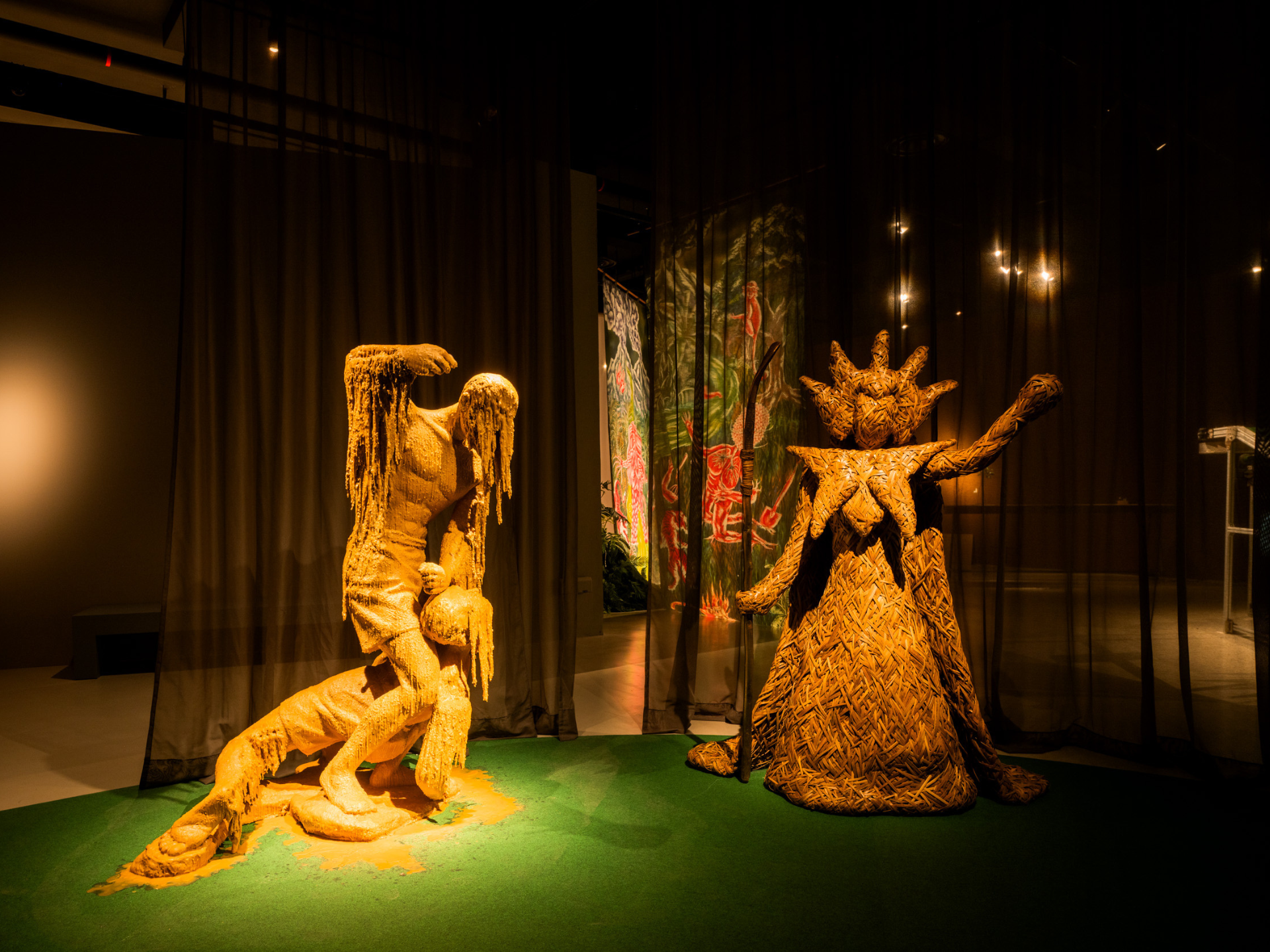
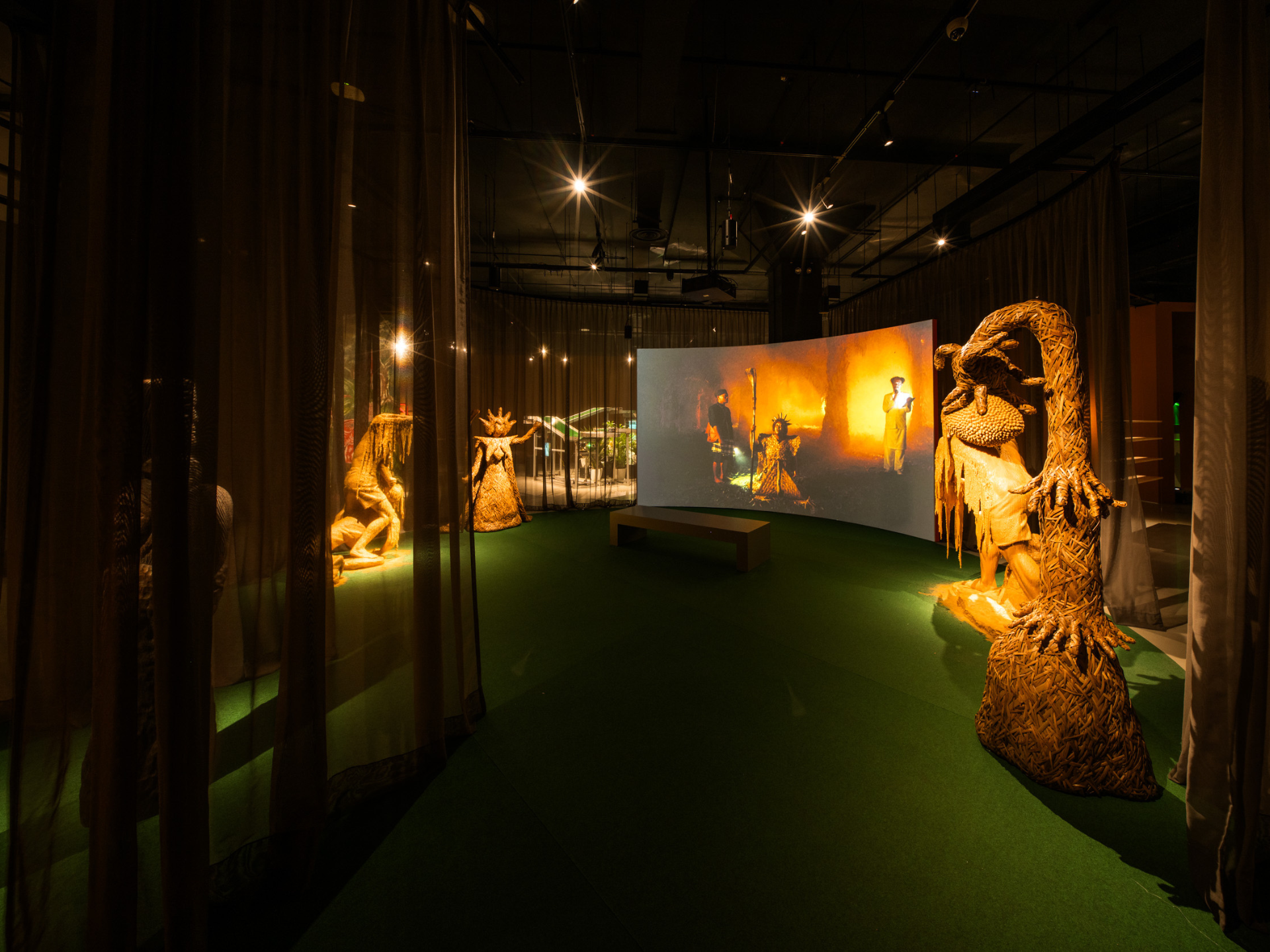
In Bodies in Penumbra: The Soft Machinery of Light, figures and fragments emerge from the residues of the world of plantations. Two human figures poised, recall the grandeur of classical sculpture, yet their surfaces tell another story. Under the appearance of melted palm oil wax, the bodies seem to be slowly dissolving under invisible heat. Appearances of the monumental are instead fragile, as the artist substitutes the ideals and representation of perfection with the realities of plantation labour. A single charred palm trunk bears carved human faces, and two sculptures woven from discarded palm fronds take on a figurative form of palm oil trees. These works transform plantation residue, which once served the plantation’s economy, into both relic and resistance, quiet monuments to exhaustion, planned obsolescence and the persistence of materials after their intended use.
Installation view of Elia Nurvista’s Bodies in Penumbra: The Soft Machinery of Light (2026) as part of Elia Nurvista and Bagus Pandega: Nafasan Bumi ~ An Endless Harvest at SAM at Tanjong Pagar Distripark. Image courtesy of Singapore Art Museum.
Elia NurvistaExhausted
2026
Batik technique on cotton fabric and palm oil wax; Collection of the artist;
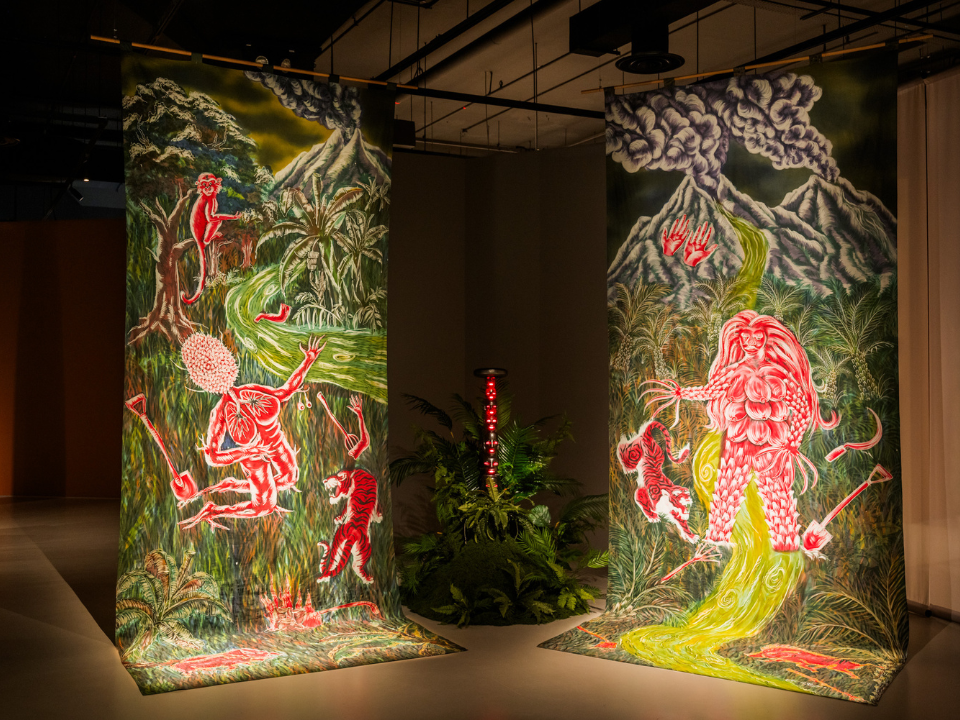
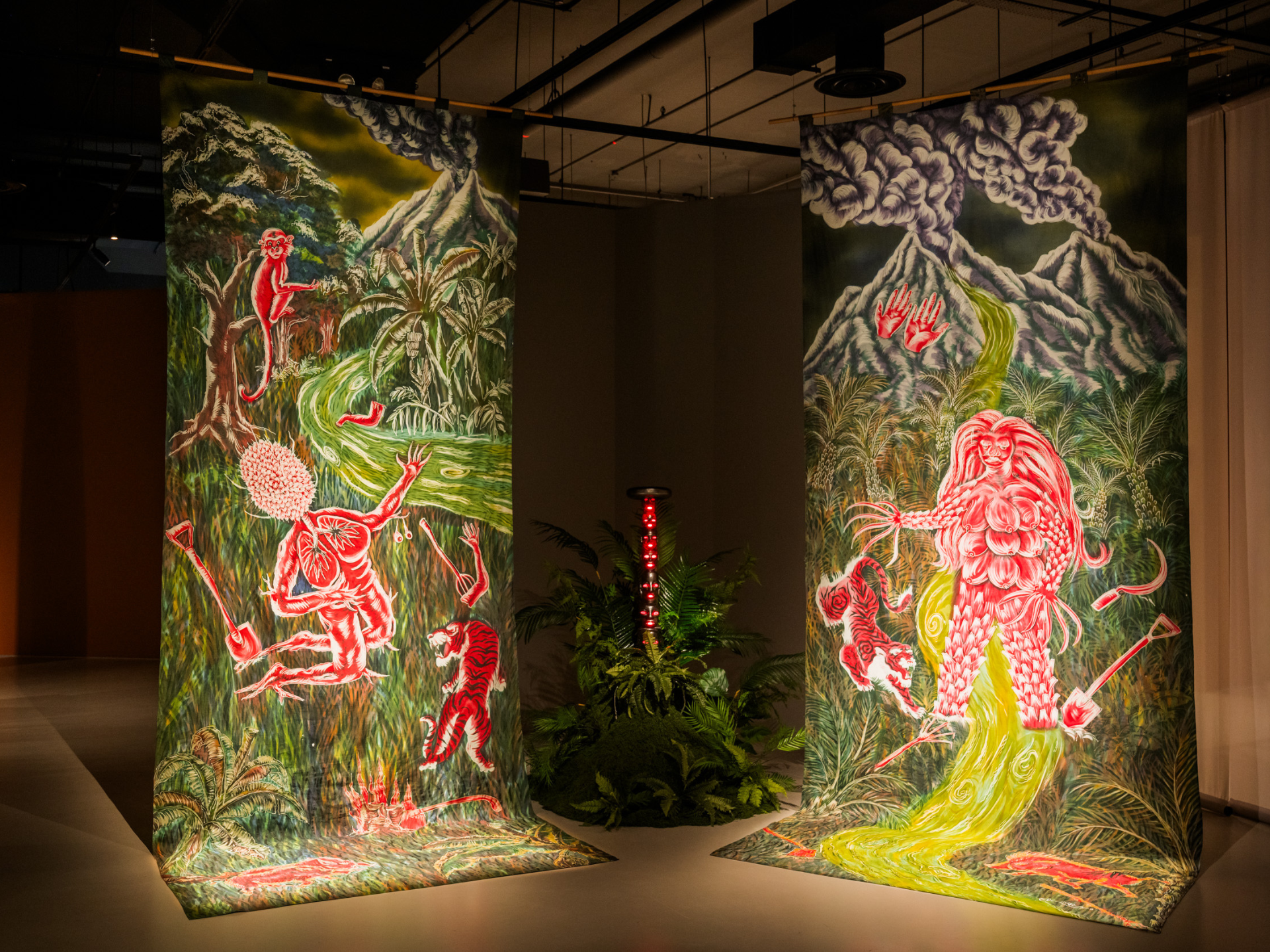
Elia Nurvista's Exhausted turns palm oil wax into a material of memory. Extending from her batik work The Route (2024), part of the ongoing Long Hanging Fruit series, the earlier work traces the linked histories of palm oil and Dutch-African wax prints. Using batik’s wax-resist process, this new work depicts palm trees and fruits within a plantation, as well as the hands and bodies that harvest them, the latter portrayed as mutating under the toxic conditions, drawing attention to the women whose unseen labour sustains these plantations.
Installation view of Elia Nurvista’s Exhausted (2026) as part of Elia Nurvista and Bagus Pandega: Nafasan Bumi ~ An Endless Harvest at SAM at Tanjong Pagar Distripark. Image courtesy of Singapore Art Museum.
Bagus PandegaFabric of the Earth
2025
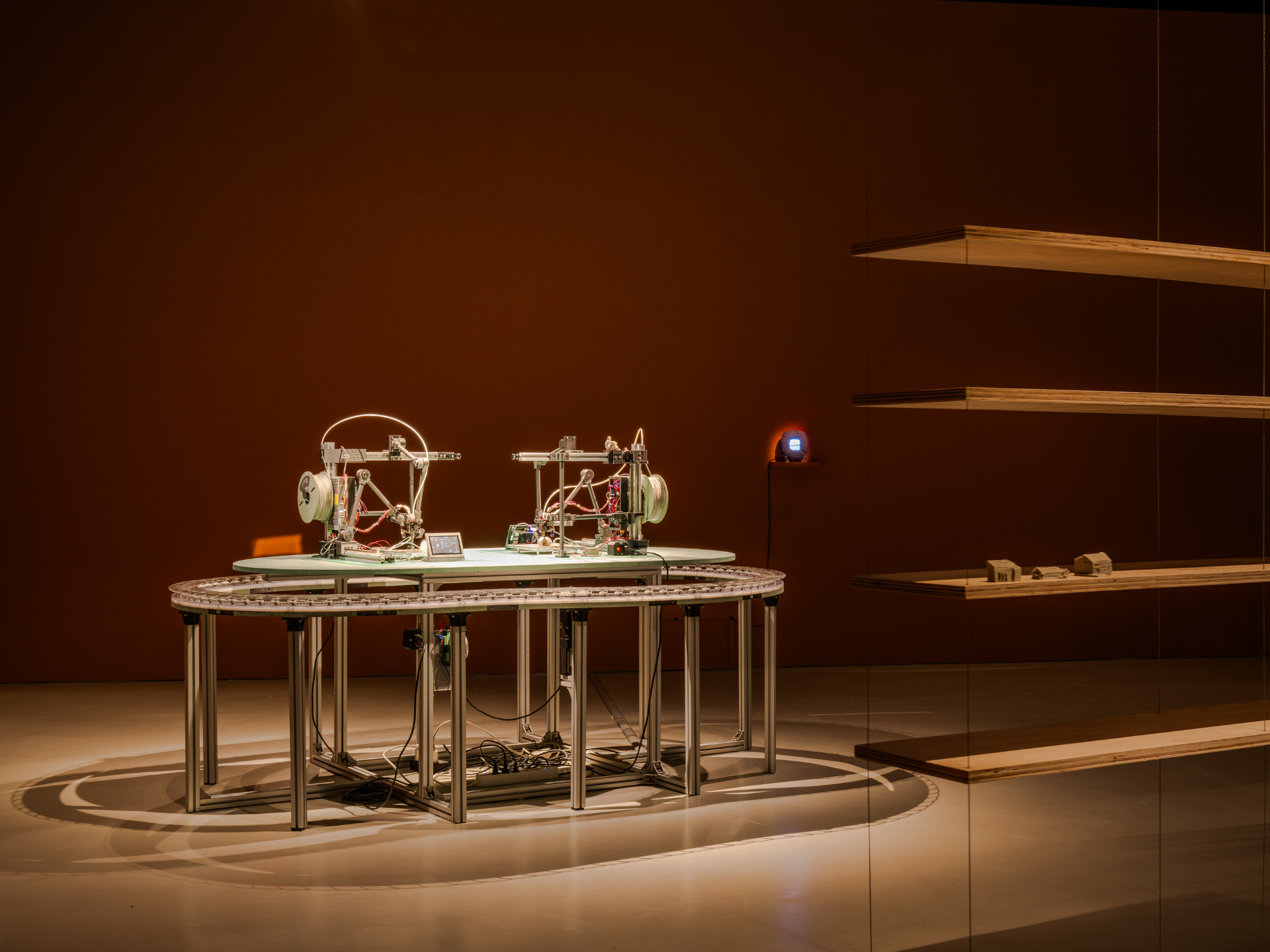
Single-channel video on loop, programmed motorised conveyor machine, DIY-modified Tripteron 3D printer, Sidoarjo mud filament and customised pegboard. ; Dimensions variable; Conveyor system engineering: Ario Wibhisono; Filament collaboration with Indofilam; Collection of the artist ;
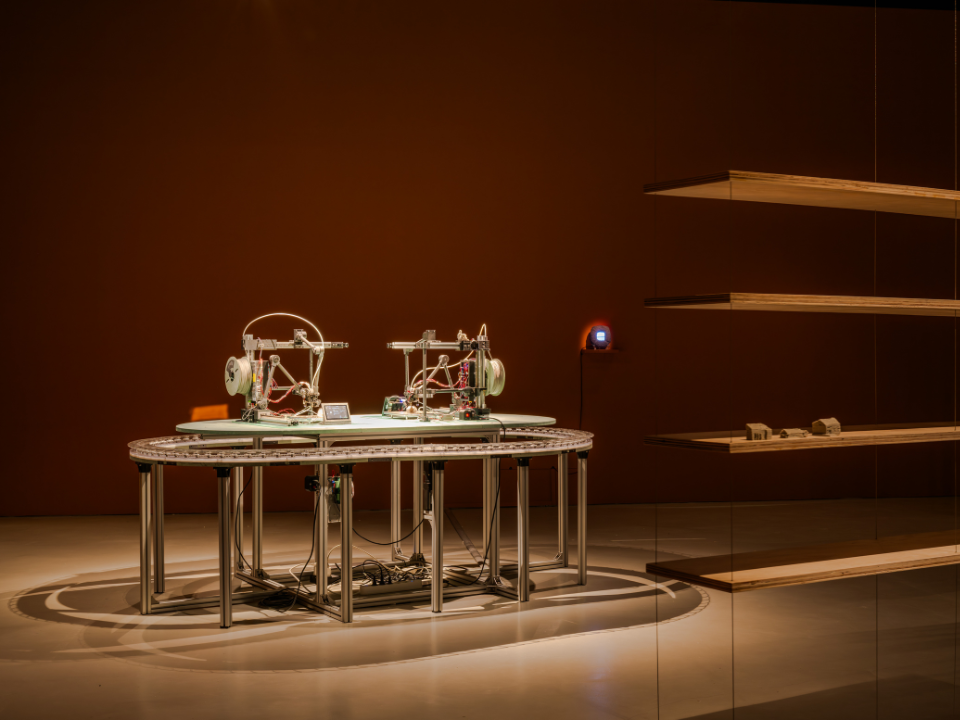
Upon a slow-moving conveyor, small 3D-printed sculptures—houses, lilies, shrimps, and seated figures—travel in quiet procession. Some of these forms were modelled from drawings made by residents who once lived near the site of the 2006 Sidoarjo mudflow disaster in East Java. These forms are printed using filament produced from the same mud, from the gas-drilling accident, which continues to release mud to this day. An Indonesian flag stalked into the still-erupting ground loops in an accompanying video, demonstrating the depth of the source. Echoing this endless outpouring/flow of mud, the printing of the sculptures continues throughout the exhibition, expanding the installation over time and transforming it into a time-based record of production and displacement, echoing the ongoing expansion of the mudflow itself.
Installation view of Bagus Pandega’s Fabric of the Earth (2025) as part of Elia Nurvista and Bagus Pandega: Nafasan Bumi ~ An Endless Harvest at SAM at Tanjong Pagar Distripark. Image courtesy of Singapore Art Museum.
Bagus PandegaGurat Lara (Scars)
2026
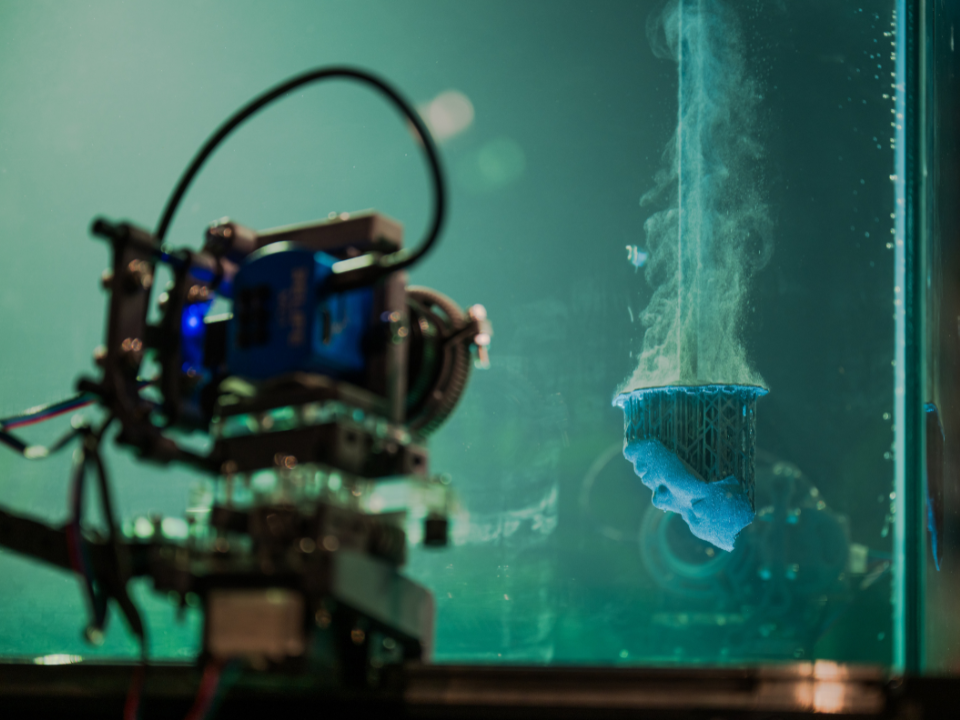
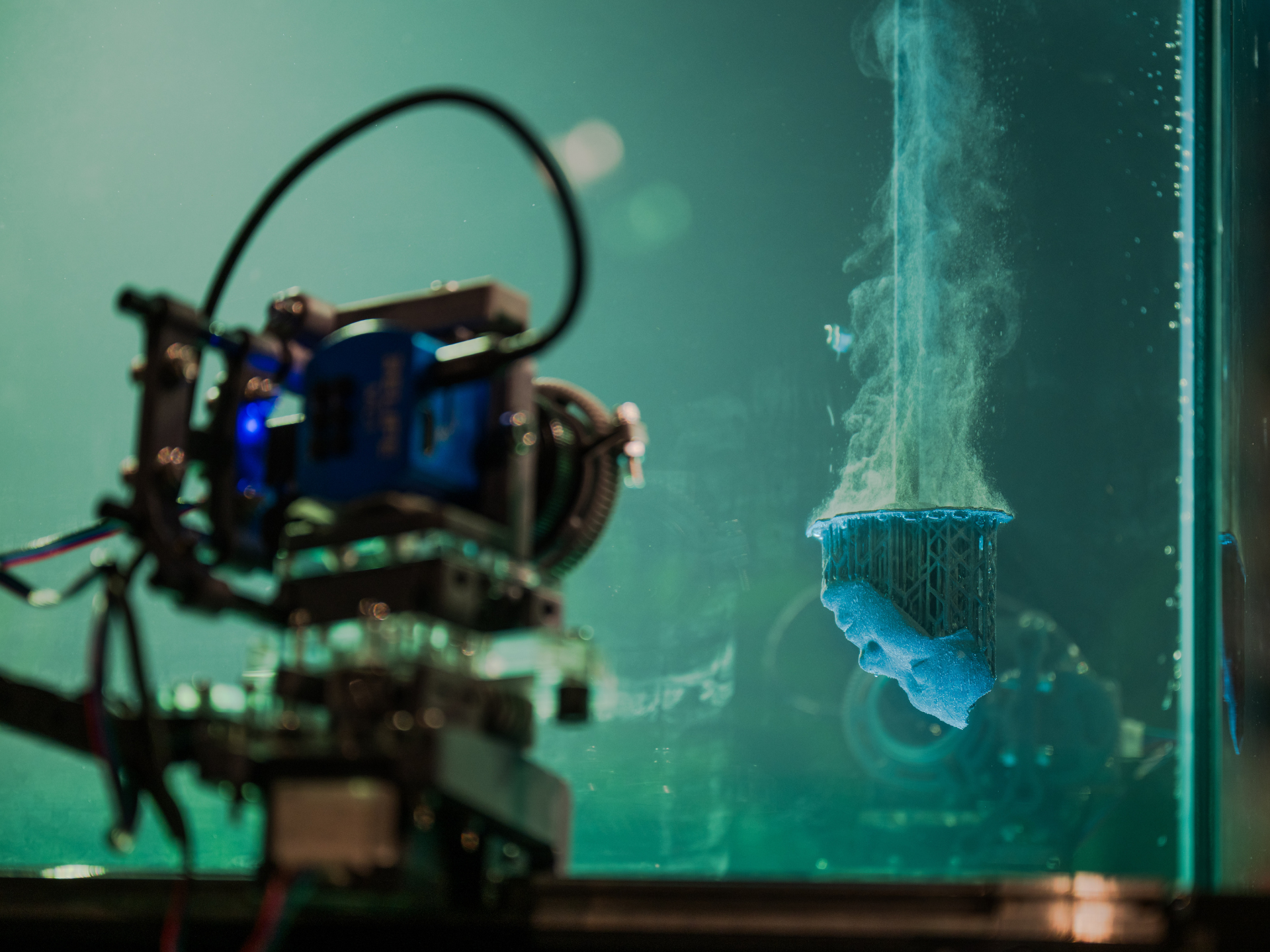
Three-channel video on live feed, nickel-plated copper-coated sculpture, DIY nickel-plating solution, aquarium; Dimension variable; Collection of the artist;
A copper-coated sculpture is submerged into a tank of electrolyte solution, bearing the face of Bagja, a nickel mining worker who had been subjected to workplace abuse. Through natural chemical interaction, Bagja’s face and features are continuously layered with nickel. The process continues throughout the exhibition, with the transformation being broadcast in real-time across L.O.O.P (Less Organic Operation Procedure). Even the screens themselves contain nickel. The live image appears inverted, turning the upward rise of hydrogen bubbles into a downward fall that resembles rain or tears. Indonesia remains the world’s largest producer of nickel, where intensive mining has led to widespread deforestation, polluted waterways, and toxic soil conditions. Gurat Lara (Scars) examines how these environmental shifts disrupt not only ecosystems but also the social and spiritual ties that bind communities to their land.
Detail view of Bagus Pandega’s Gurat Lara (Scars) (2026) as part of Elia Nurvista and Bagus Pandega: Nafasan Bumi ~ An Endless Harvest at SAM at Tanjong Pagar Distripark. Image courtesy of Singapore Art Museum.
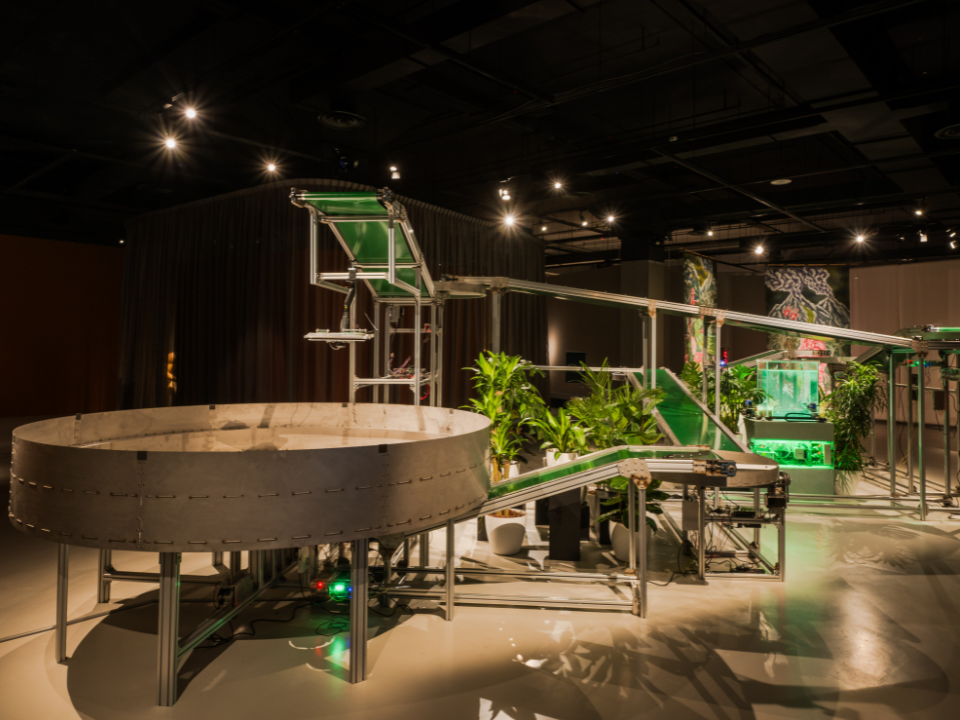
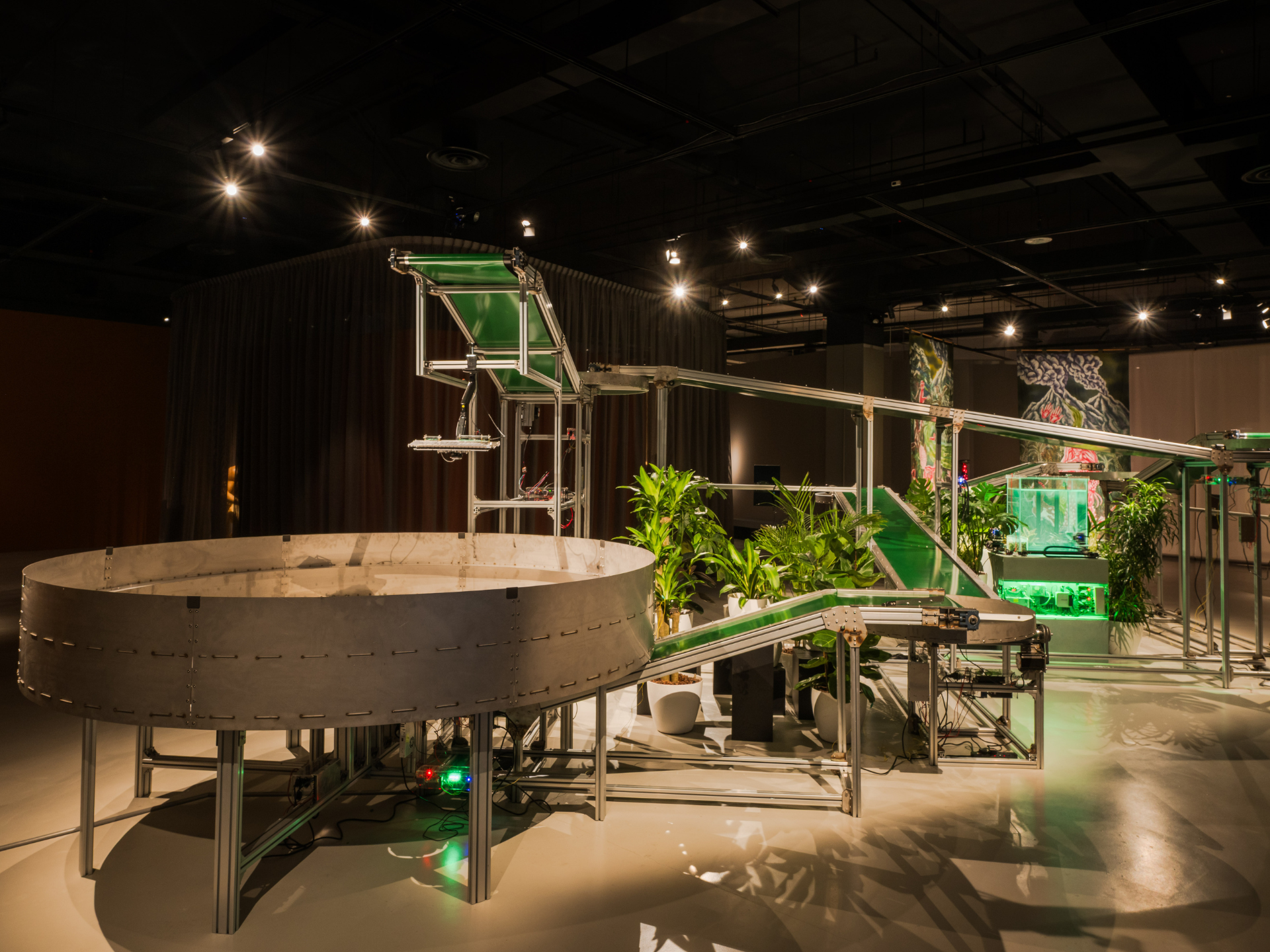
Programmed motorised conveyor machine, tropical plants, nickel ore and customised electrical biofeedback receiver; Dimensions variable; Collection of the artist;
Fragments of nickel ore move in a measured rhythm along a ten-metre conveyor belt. While mechanical in nature, the machine’s tempo is not dictated by machine nor human, but by the tropical plants around it whose biofeedback signals regulate its motion. Travelling to the end of the conveyor loop, the ore is dropped into a metal basin, producing a resonant strike that marks the passage of time. In this installation, industrial mechanisms and living systems share a single circuit. Nickel, drawn from the red earth of Sulawesi, meets the biological responses of plants. Here, mining is reimagined as a system responsive to nature, which once extracted, becomes the operator. Across this looping system of movement and sound, the artist reflects on labour, technology, and the shifting boundaries between the organic and the mechanical.
Installation view of Bagus Pandega’s L.O.O.P (Less Organic Operation Procedure) (2026) as part of Elia Nurvista and Bagus Pandega: Nafasan Bumi ~ An Endless Harvest at SAM at Tanjong Pagar Distripark. Image courtesy of Singapore Art Museum.
Elia NurvistaPlantation Tragedy
2026
Single-channel, 16:9 aspect ratio, colour and sound (multi-channel), 30 min; Collection of the artist;
Plantation Tragedy presents a surreal dreamscape where trees, labourers, scientists and artificial intelligence confront one another in a shared state of exhaustion. Four figures—Francis the overseer, Dona the vegetal communicator, Watiman the scientist and Cyborg the sentient machin e—voice conflicting desires for progress, justice and rest. The oil palms begin to groan, complain and ultimately refuse to produce, a fantasy of vegetal strike in action. As the trees “strike,” the plantation becomes a scene of imagined resistance, inviting us to consider whether the Earth itself might one day refuse and retaliate.
Installation view of Elia Nurvista’s Plantation Tragedy (2026) as part of Elia Nurvista and Bagus Pandega: Nafasan Bumi ~ An Endless Harvest at SAM at Tanjong Pagar Distripark. Image courtesy of Singapore Art Museum.

 Buy Tickets